
Full-Canvas vs. Half-Canvas Tuxedos: What Is the Difference?
The layer of material sewn inside a tuxedo jacket does more work than most people realize. It determines how the jacket holds its shape, how it drapes across your chest, and whether it molds to your body over years of wear or stays stiff against it. Most buyers focus on fabric weight, lapel style, and button count, but the internal construction is what separates a jacket that looks good on a hanger from one that looks like it was built for you. The question of full-canvas vs. half-canvas tuxedos comes down to a single structural layer called the canvas, a woven interlining that runs through the chest of the jacket and forms the foundation of everything above the waist. Understanding what that layer does, and how much of it your jacket contains, tells you a great deal about how the garment will perform over time, how it will feel after a full evening, and what the investment actually buys you.
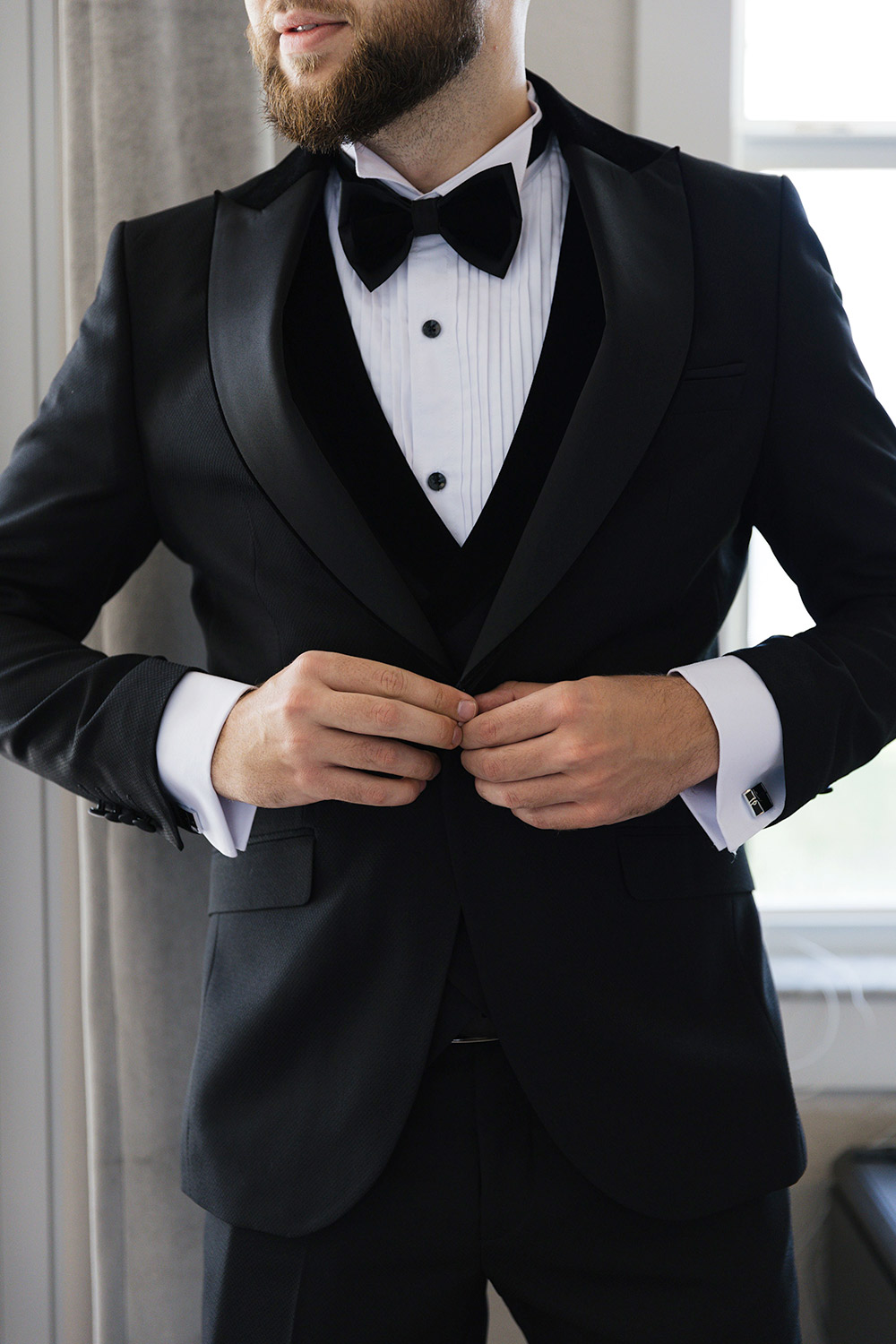
Photo: pexels.com
Understanding Canvas Construction in a Tuxedo
Canvas construction is what gives a tuxedo jacket its shape, structure, and drape. Buyers who want to order a tuxedo from Alan David Custom or from other custom tailors and made-to-measure shops will often come across full-canvas, half-canvas, and fused construction options. Each method uses a different amount of internal support, which affects how the jacket feels, moves, and holds its shape over time. Full-canvas and half-canvas designs rely more heavily on a sewn-in interlining, while many ready-to-wear tuxedos use partial or fully fused construction to keep production costs lower.
What Full-Canvas Construction Means
Full-canvas construction runs the interlining from the collar all the way down to the jacket's hem, covering the entire front panel on both sides. The canvas is hand-stitched to the outer fabric through a technique called pad stitching, thousands of tiny, angled stitches that bind the two layers loosely enough to shift independently while keeping them aligned. That loose attachment is the point. Because the canvas and outer fabric aren't glued together, each can move slightly as your body does, and over time the canvas starts to mirror the shape of your chest, shoulders, and torso. Experienced clothiers call this "breaking in," and it's why a full-canvas jacket from a decade ago can still look sharper than a fused jacket from last season. Full-canvas construction also lets a skilled clothier set the lapel roll with real precision, since the chest canvas and bridle stitching work together to establish a curve that holds consistently through years of wear. It's the standard in high-end made-to-measure garments, and it accounts for a significant share of the labor cost in a properly built tuxedo.
What Half-Canvas Construction Means
Half-canvas construction uses the same woven interlining but only runs it through the upper portion of the jacket, typically from the shoulder down to just below the chest pocket. Below that line, the jacket relies on fusing or lighter interfacing to hold its shape. The upper section still behaves like a full-canvas jacket in many meaningful ways: the chest molds over time, the lapel can be set with a natural roll, and the shoulders keep their structure. But because the canvas stops mid-jacket, the lower half doesn't break in the same way. You'll notice it most in the drape below the button stance, where a full-canvas jacket tends to hang with considerably more fluidity. Half-canvas is a genuine step up from fully fused garments, and it's found across a wide range of quality off-the-rack and made-to-measure tuxedos at a lower price point than full-canvas work. The trade-off scales with how often you wear the jacket and over how many years.
How the Two Constructions Differ in Wear and Fit
The real-world difference between a full-canvas and half-canvas tuxedo becomes clearer once you've worn each one for a few hours. Both constructions look sharp at the start of an evening. But full-canvas vs. half-canvas tuxedos - what is the difference when the lights go down, and the event runs long? The answer shows up in comfort and movement. A full-canvas jacket has a softness through the chest that a half-canvas jacket can approach but rarely match, because every inch of the front panel flexes in coordination with your body rather than in two separate zones. That said, the average wearer attending a handful of formal events per year may not notice the distinction in a single outing. The difference compounds over multiple seasons of wear, which is why the question of construction matters most to someone building a tuxedo they intend to keep for a decade or more.
Long-Term Shape and Drape
Full-canvas construction gives a tuxedo its best shot at aging well. The pad-stitched horsehair interlining gradually compresses and conforms to the wearer's particular posture - the slight forward lean of your left shoulder, the way your chest sits when you stand at ease - and the result is a jacket that looks more tailored the longer you own it. Half-canvas holds its shape well through the upper chest and shoulders for the same reason, but the fused lower section doesn't participate in that process. Fusing can also delaminate over time, especially after repeated dry cleaning, as the adhesive bond separates and leaves a bubbled or stiff appearance across the lower front panels. Full-canvas jackets don't carry that risk. There's no adhesive layer to fail. So if you're putting money into a tuxedo you expect to wear regularly over many years, full-canvas is the more durable choice, not because half-canvas fails outright, but because full-canvas keeps improving where half-canvas levels off and eventually declines.
Cost, Comfort, and Occasion Fit
Full-canvas construction demands far more hand labor than half-canvas, and that cost shows up in the price. Clothiers spend hours on the pad stitching alone; bridle stitching along the lapel adds more time still. For a high-end made-to-measure tuxedo, that labor is part of what you're buying. Half-canvas lets a clothier cut production time while still delivering a jacket with real structural quality where it counts most, the chest and shoulders. For someone ordering a tuxedo for a single occasion, or for a buyer working within a tighter budget, half-canvas is a reasonable and honest choice. But for a garment you plan to wear to weddings, galas, charity dinners, and formal evenings over the next fifteen years, the added investment in full-canvas pays back through appearance, comfort, and longevity. Neither option, though, delivers its full value from a fused jacket. Construction is the foundation, and fabric choice comes after.
The full-canvas vs. half-canvas tuxedos question - what is the difference, practically speaking? - is really a question about how long you plan to own the jacket and how often you'll wear it. Full-canvas construction breaks in, molds to your body, and holds its shape for years without the delamination risk that comes with fusing. Half-canvas offers genuine quality in the upper chest and shoulders at a lower labor cost, and it's the right answer for many buyers. Both are far superior to fully fused construction. Your decision should reflect your timeline, your budget, and the occasions you're dressing for - not just what sounds more impressive on a spec sheet.
Hits: 54 | Leave a comment
Tags:menswear, tuxedo, full canvas, half canvas
About the Author

Silvia Kabaivanova
As the founder of Be Global Fashion Network and several other fashion websites, Silvia has been working for more than 20 years covering fashion industry trends and news. With a passion for the fashion business, she focuses on sustainable fashion and innovations, custom fashion and print on demand services. Silvia is a Chairman of Bulgarian Fashion Association. You can reach her at silvia@bgfashion.net