
Dinosaur Collagen Inspires Creation of a One of a Kind Handbag
The luxury fashion industry has seen its share of unusual materials, from mushroom leather to fabrics grown in laboratories. But a new creation unveiled in Amsterdam has pushed the boundaries of innovation even further: a luxury handbag made using bioengineered collagen inspired by the Tyrannosaurus rex.
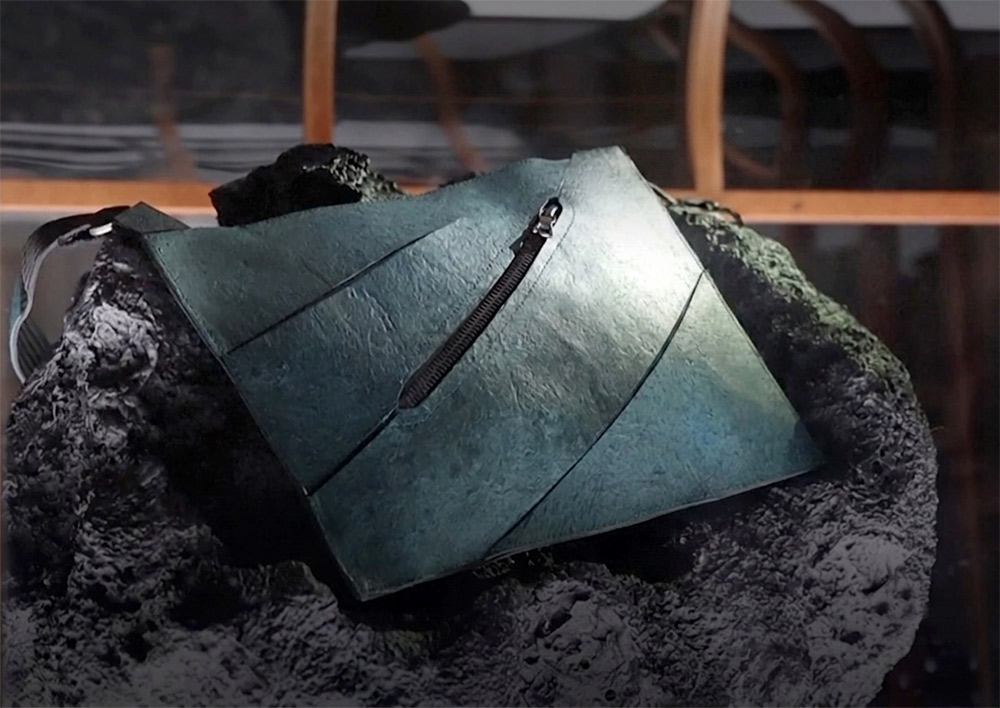
The one-of-a-kind accessory, displayed beneath a towering T. rex replica at Amsterdam's Art Zoo Museum, represents a collaboration between biotechnology researchers, material scientists, and fashion designers. Rather than using traditional leather, the team developed a material based on reconstructed collagen sequences linked to ancient dinosaur fossils, creating what they describe as "T. rex leather."
While the phrase immediately conjures images of prehistoric skin transformed into couture, the reality is more complex. Scientists did not extract leather from dinosaur remains. Instead, researchers analyzed fossilized protein fragments, used computational biology to reconstruct missing sections, and engineered cells capable of producing collagen inspired by those ancient molecular traces. The resulting material was then cultivated and processed into a leather-like biomaterial.
For the fashion world, the project is less about dinosaurs and more about the future of luxury materials. Traditional leather production faces increasing scrutiny over its environmental impact, from livestock farming to chemical-intensive tanning processes. Biofabricated alternatives offer designers an opportunity to rethink luxury without relying on conventional animal hides. Supporters argue that engineered materials could eventually provide durability, traceability, and lower environmental costs while maintaining the premium feel consumers expect.
Not everyone is convinced by the prehistoric branding. Several paleontologists have questioned whether the material can truly be described as dinosaur leather, noting that collagen recovered from fossils exists only in fragmented forms and does not contain enough information to recreate genuine dinosaur skin. Critics suggest the project is best viewed as a creative biotechnology experiment rather than a direct resurrection of a prehistoric material.
Yet controversy may be part of the appeal. Luxury has always thrived on rarity, storytelling, and exclusivity, and few stories are more compelling than carrying a handbag linked—however indirectly—to a creature that ruled the Earth more than 66 million years ago.
The handbag itself is expected to be auctioned as a collector's item, but its significance extends beyond a single accessory. The project offers a glimpse into a future where fashion materials are designed at the molecular level, blending synthetic biology, sustainability, and high-end craftsmanship. Whether "T. rex leather" becomes a commercial reality or remains a fascinating experiment, it has already achieved one thing: turning a scientific breakthrough into one of the most talked-about fashion stories of the year.
Hits: 1981 | Leave a comment
About the Author

Laura Palazzi
Laura holds a two-year technical degree in Marketing, Communication, and Logistics from St. Louis – Ste. Marie School in Gignac-la-Nerthe, France. Passionate about fashion, she enjoys writing about the latest fashion trends, branding, and marketing strategies.



 (4)m.jpg)